


For detailed information, other images and documents, please select individual articles from the following table.


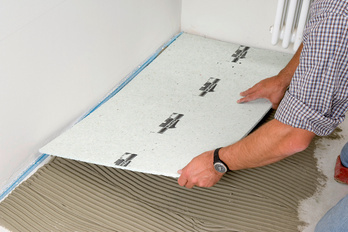
CERAfix 206 sound-absorbing and uncoupling panel
For coverings such as ceramics, natural stone and parquet, as well as under carpets and plastic coverings after filling.

Register now and access more than 125,000 products

Variants
Register now and access more than 125,000 products
Easy to use
- Can be used on easy-to-adhere surfaces with a class C2 thin-bed adhesive.
- Can be covered with conventional laying materials.
- Suitable for underfloor heating (4 mm version only).
High crack resistance and compressive strength - suitable for working loads up to 5 kN/m².
Low emissions
- Polyester fibre panel
- Eco friendly - contains no hazardous substances. Leftover product can be disposed of as construction site waste
Electrical underfloor heating is significantly more effective on CERAfix 206 due to its excellent heat insulation; the ideal addition under ceramic and natural stone coverings.
The usage instructions are recommendations based on the tests we have conducted and our experience; carry out your own tests before each application. Due to the large number of applications and storage and processing conditions, we do not assume any liability for a specific application result. Insofar as our free customer service provides technical information or acts as an advisory service, no responsibility is assumed by this service except where the advice or information given falls within the scope of our specified, contractually agreed service or the advisor was acting deliberately. We guarantee consistent quality of our products. We reserve the right to make technical changes and further develop products.
CERAfix 206 can be used as an uncoupling layer for all types of surface coverings such as ceramics, natural stone and parquet, as well as under carpeting and plastic flooring after filling. It can be used on surfaces such as screeds, filled concrete surfaces, old hard coverings and wooden substrates. The high compressive strength of CERAfix 206 enables application under surface loads of 5.0 kN/m2, i.e. in residential and commercial properties.
The uncoupling effect works by reducing shear stresses in a cracked substrate (crack width
≤ 0.5 mm) or a substrate with disruptive movement joints due to plastic deformation within the panel.
In addition to restoring critical substrates, CERAfix 206 can be used in new-build projects to significantly reduce the number of unsightly movement joints in a rigid floor covering.
The base material must be dry, load-bearing (live load >1.0 Kn 7 m2 DIN 1055) and flat in accordance with DIN 18202, table 3, row 3. For absorbent and slightly sandy surfaces, prime with CERAfix 101, CERAfix 102 or CERAfix 103.
The decoupling panels are adhered to the base material using PLUS CERAfix 403 light tile adhesive and laid in a semi-lattice pattern. To do this, apply the PLUS CERAfix 403 light tile adhesive with a 6 mm notched trowel and immediately
insert into the decoupling panels. The top coat can be applied once the adhesive has cured. In damp and wet areas, CERAfix 305 is applied beforehand for sealing purposes.
Sufficient edge distances must be observed for all components sitting on top of the surface, such as supports and walls. To prevent noise bridges and loads, it is recommended to use an edge insulating strip.
Before laying carpet and plastic coverings such as lino, PVC or CV, it is recommended that the decoupling panels be filled to create a joint-free surface.
The panels can be cut with circular saws and jigsaws or with a cutting disc set with diamonds for an angle grinder.
Select RAL-colour code
!! NOTE: On-screen visualisation of the colour differs from real colour shade!!